News of Missionary’s Death Underplayed Amid Vigilance in Ecuadorian Village

Elisabeth Elliot 1926-2015
To a few people in Tiwino and several other villages in Ecuador’s
Amazon region, Monday June 15, may have been significant in that
thousands of miles away in the U.S., Elisabeth Elliot died at age 88.
After a successful career as a Christian author, radio program host
and conference speaker, Elliot passed “through gates of splendor” for
her eternal heavenly reward, according to Christian media reports that
artfully reprised the title of her first book,
Through Gates of Splendor. A memorial service is set for Sunday, July 26, in Edman Chapel at Wheaton College in Wheaton, Ill.
In the book published in 1957, Elliot recounted how just a year
earlier five missionaries—one of them her husband—died in their efforts
to spread the gospel to a violent tribe in Ecuador that lived a Stone
Age existence. Once known as
Aucas, they are more accurately known today as
Waorani (plural) or as
Wao (singular) which is pronounced like the exclamative, “wow.”
These days, descendants of those Waorani live a different lifestyle,
having set aside revenge for the most part. They use their spears for
hunting. Features such as forgiveness and reconciliation have propagated
the culture of those who follow the teachings of Christianity.
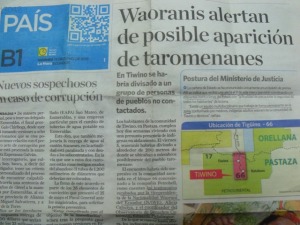
To some of the
Waorani—if they’ve received word of the death
of Elliot, a former missionary to Ecuador—the news may have been
overshadowed by another event. That event has been termed a potential
threat to one of the small communities some distance from the place
where the five missionaries died on the Curaray River in the Ecuadorian
rain forest. Less than a week before Elliot’s death in Magnolia, Mass.,
Tiwino was placed on alert. Witnesses had reported seeing nearby some
people whom they believed were part of a reclusive group known as
Taromenane.
Even as many Waorani have found ways to co-exist or even assimilate
into an encroaching dominant culture, the Taromenane, biologically
related to the Waorani, have withdrawn into the jungle. The
Tarome—with
a different spelling in the Wao* language—signifies that they are over
landers whereas other subset groups are known as either upriver or
downriver people. Their contacts with the other Waorani have been
sporadic and at times lethal as traditional revenge killings at times
have returned.
“On June 5 the Waorani spotted some 200 meters away people who are possibly Taromenane,” reported the Quito newspaper,
La Hora. Another Quito daily,
El Telégrafo,
stated that “the Ministry of Justice, Human Rights and Religious
Affairs, through the Directorate for the Protection of Indigenous
Peoples in Voluntary Isolation, activated the Protection Protocol that
allows monitoring and tracking.”
A multidisciplinary team of physicians, local Waorani and government
workers are in Tiwino to help with contingencies in case hostilities
develop between the two indigenous groups.
Contact by Outsiders Leads to Cultural Changes
The older Waorani—as well as some Amazon-region
Quichua and the Tsachila people of Ecuador’s western jungle—remember
that Elliot and other evangelical Christians contributed to cultural
changes. Some recall the Waorani abandoning a lifestyle of killing in
the 1950s and 1960s and embracing the gospel of Jesus Christ.
For centuries before the gospel was preached in Ecuador’s Amazon
region, violence had awaited those who trekked in. People did not return
if they went into Waorani territories. The Waorani, in addition to
killing outsiders, also turned their long spears of sharpened chonta
palm wood onto each other in revenge killings.
Few Waorani lived to an old age, for spearing deaths were common. The
naked forbears of today’s Waorani roamed a vast area of the jungle and
were known by the term “savage” (or Auca) by Ecuador’s lowland Quichua
people with whom Elliot was acquainted.
“We were working with the jungle Quichua tribe and reducing their
language to writing, doing some Bible translation,” recalled Elliot in a
mid-1990s interview with Reach Beyond’s Curt Cole that aired on Radio
Station HCJB. (Then a program host, Cole now serves as the mission’s
senior vice president of international ministries.) Elliot related that
Mission Aviation Fellowship (MAF) pilot Nate Saint “came in one day with
a very exciting piece of news, which was that he had discovered the
whereabouts of a tribe that no one had been able to contact.”
In the home of Nate and Marj Saint in Shell, Ecuador, the
missionaries anticipated reaching out to the Waorani. Elliot told Cole
that her husband, Jim, and others “made the attempt to go in after a
very long and careful planning period and dropping of gifts to these
people with the hope that they might reduce the hostility.”
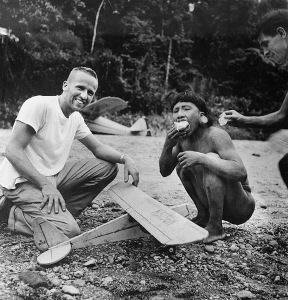
“When they received what appeared to be very positive signs of
friendliness,” she said, “they felt that it was time to move into the
edge of their territory and set up camp. They did not go barging into
the Auca houses. But they hoped that the Indians would find them. They
prayed that this would happen … and it happened.”
Evangelistic Efforts Defy All Odds
The Waorani found the five missionaries at the
river and befriended them. Elliot told Cole that “two women and one man
had come out and exhibited such friendliness that they actually ate the
stuff the men gave them, can you imagine—a hamburger with mustard and
lemonade—things that were not remotely like anything they’d ever seen.”
However, their evangelistic success seemed short-lived as other
Waorani came and killed all five of them, leaving the plane shredded but
largely intact on the shore of the Curaray River on Jan. 8, 1956. Marj
Saint had waited for a Sunday-afternoon call on the radio from the men.
But no call came. Days afterwards in the Saints’ kitchen, Dr. Arthur
Johnston, a missionary physician serving at
Hospital Vozandes-Shell, helped to inform Elliot and the other wives that their husbands had all been killed.
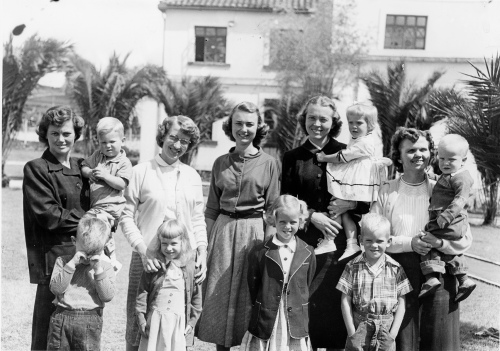
Elisabeth
Elliot (second from right, holding Valerie) with the other four
missionary widows. Left to right: Marilou McCully, Barbara Youderian,
Olive Fleming, Elisabeth Elliot, Marj Saint.
In an HCJB broadcast, Clarence Jones, mission [now Reach Beyond]
cofounder and president, said that “we are sure that these lives which
have been given in the spread of the gospel will bear wonderful fruit
for God’s glory. We feel that this will definitely be the first step in
reaching these heathen people with the gospel of our Lord and Savior
Jesus Christ.”
“As we contemplate that God has given victory and that there is
wonderful evidence of His sustaining grace,” Jones continued, “we would
like to urge all of you to pray clearly and definitely for further
consolation from the Lord for these five women who definitely need the
guidance, instruction and help of the Lord in these very trying days.”
In regular contact with NBC, Jones told the New York City-based radio
and television network that findings by the search committee that went
to the Curaray indicated, “that there was a sudden attack of some kind,
and evidently they were dealing on a friendly basis with the Auca
Indians and were taken by such sudden surprise that five strong men were
immediately killed.”
Tale of Two Villages: Tiweno and Tiwino
Two years later (in 1958) Elliot went to live among the Waorani with
her young daughter, Valerie, and Rachel Saint, whose brother, Nate, had
also been killed by spearing. Together they ministered to the Waorani
for about two years, and those who killed the missionary men were some
of their first converts. After that, Elliot moved to the U.S. with her
daughter.
Tiwino [Tigüino], site of the present alert in Ecuador’s Amazon
region, is not the same community as Tiweno [Tihueno], a settlement sewn
with the seeds of Christianity in Rachel Saint’s earlier years in
Ecuador.
At one point in the late 1960s however, Tiweno attracted warring
factions of Waorani, with Saint in the middle of it all. Reach Beyond
retired physician Dr. Wally Swanson related decades afterwards that,
“here was a group from the south [jungle] and a group from the north
[jungle] meeting at Tiweno with a group that had been only their enemies
in the past—that they had fought with and killed and speared.” Swanson
researched and documented the Waorani as part of his medical licensing
in Ecuador.
Swanson interviewed Waorani for the research, learning that “there
was not one single male adult in their living memory—grandfathers, great
grandfathers, uncles—that had … not died by spearing.”
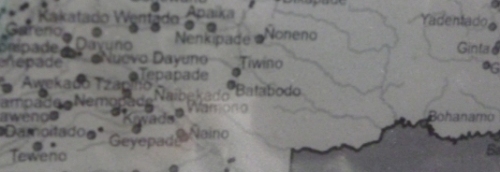
Tiweno (lower left) and Tiwino (central in photo) are two different jungle communities in Ecuador.
“All of them had died violently,” Swanson continued. “And 75 percent
of the women and children who had died (whom the interviewees knew about
and could remember) had died in the same way.”
“The tendency to idealize or romanticize ‘primitive’ cultures falls
to crushing blows … as the reality of life in the upper Amazon
rainforest plays out in gruesome details often too explicit and vivid
for the cushioned Western mind,” wrote
Jim Yost and
Chet Williams in the foreword of a book in which three Waorani tell of life before and after encountering Jesus Christ.
Analyzing the Waoranis’ traumatized collective psyche, Yost continued
that “in the first decade that I lived among the Waorani, I doubt a day
ever passed that I didn’t hear the wrenching stories of past
atrocities.”
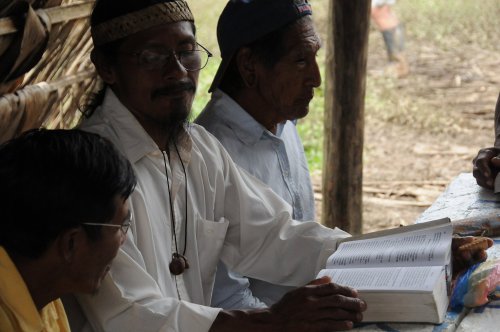
Kawia
(with open Bible) sits between Menkaye, on his left and another person.
Kawia and Menkaye are literate and both are Christians. Photo by Daniel
Klassen.
“The reason is obvious—watching parents, children or siblings
murdered in their sight burned indelible memories and emotions that
could be erased only by a total transformation of the spirit,” said
Yost, a missionary anthropologist with the Summer Institute of
Linguistics. “The fact that that transformation has taken place is the
real story here.”
The book itself, published in 2013, was authored by the missionaries’
killers at the beach, Menkaye Ænkædi (with friends Kemo and Dyowe). If
it strips away support of the noble savage literary concept, so too does
the book address evangelical renditions of the Waorani story. Most are
told exclusively from a Western context. Additionally, a literature
review might leave researchers and others with the idea of mission
accomplished.
Truly, the culture has changed; that is undeniable. Menkaye, however, insisted upon the title,
Gentle Savage Still Seeking the End of the Spear,
according to translator Tim Paulson, “because it’s been stated in the
outside world that the days of spearing among the Waorani are over,
which is far from the truth. It’s still very much a way of life,
especially for the
Tagaeri and the
Taromenane who
remain isolated and intentionally out of reach by even the upriver
Waorani. But even among the upriver Waorani, who have had significant
contact with the outside world, spearing is far from over.”
Circumstances amid tribal tensions in Tiweno in the late 1960s
worsened when a polio outbreak began to take people’s lives and mutual
suspicions grew on just whose sorcery was behind it. But Swanson and
other missionaries were called in by Rachel Saint.
They capably rescued those they could with evidence-based medical diagnoses and by
using rudimentary equipment similar to playground seesaws
to keep the polio victims breathing. Not all the Waorani lives were
saved, Swanson said, and missionaries successfully convinced the
survivors that the bodies of those who had died were not cannibalized by
the foreigners.
After more than 35 years among the Waorani, Saint died and was buried
at the village of Toñampare near the site where her brother and the
four other men were killed on the Curaray River. The village is named
after a stream that runs through the area. Toña, a Waorani born there,
later became an evangelist and was killed in his attempt to share the
gospel of Christ with a hostile subgroup, according to Ethel Wallis in
her book,
Aucas Downriver.
Oil Exploration Encroaches on Indigenous Groups
Because life always moves on, the Waorani story
does not freeze frame where Elliot’s book ends. So too, development in
the Amazon region threatens the hunter/gatherer lifestyle of the
Taromenane as oil exploration and extraction continues. When in March
2013 in Ecuador’s Orellana province, two elderly Waorani, Ompore Omeway
and Buganey Caiga, were speared to death, the suspicions of fellow
Waorani fell on the Taromenane. The spearings occurred near the village
of Yarentaro at the edge of the Yasuní Preserve where the Taromenane
still roam freely.
Rumors abounded and different antecedents were offered as possibly
explaining the motivations behind the killings. One generally accepted
theory centers around deaths of the Taromenane from contaminated food
dropped from an aircraft. Another explanation was that the Taromenane
viewed Omeway as a liaison between their world and that of the
cowode (outsiders). When his advocacy failed, the relationship went awry.
A year after the elderly Waorani were killed, approximately six Waorani men were imprisoned for what
court proceedings determined were their roles in avenging the couple’s deaths by killing up to 30 people.
The “official version” of what happened, according to a statement by the
Organización de la Nacionalidad Waorani de Orellana
(Waorani Nation Organization of Orellana or ONWO) was based upon
conversations with families and relatives of Omeway and Caiga. The
statement also lamented about the loss of land to “deforestation,
agriculture and cattle ranching.”
The ONWO account stated that the Taromenane had “expressed their
anger to Omeway and Caiga about the noise, unknown crop planting, too
many
cowode [outsiders], trees being cut down and [oil rigs].”
The Taromenane had demanded advocacy by the Waorani couple with the
outsiders, but “evidently, Omeway and Caiga could not help,” indicating
this may have provoked the attack.
When a judge dismissed the case against them, the prosecutor, Andrew
Causapaz, submitted a motion for “nullification and appeal” of the
dismissal. Causapaz said in an appeal hearing that the allegations
against the Waorani were based in part on pictures they had taken, along
with shotgun shells, pots with traces of pellet impacts and up to 100
other pieces of evidence. Initially, the Waorani were charged with
genocide, but the charge was amended to murder in compliance with a
provision of the Constitutional Court that also studied the case.
Ecuadorian Attorney General Galo Chiriboga had indicated in mid-2013
that Ecuador’s government would exact justice for the deaths and not
repeat the error of 2003, referring to internecine violence by Waorani
fighters against the Taromenane.
No formal charges followed the 2003 killings. An international body,
the Inter-American Commission on Human Rights, later requested Ecuador’s
protection for the nation’s non-contacted peoples, and government
officials granted the request. Ecuador’s protection protocol,
implemented by the Directorate for the Protection of Indigenous Peoples
in Voluntary Isolation, is Ecuador’s answer to that request from more
than a dozen years earlier.
Given the complexity of the situation, can forgiveness or
reconciliation prevail? Will the impact of the gospel message—one that
Elliot promoted in her early years in Ecuador and that Waorani believers
live by today—someday, somehow reach the unreached Taromenane?
*
Waorani can also be spelled Taadömënäni (taadö for trail and
näni which is plural). So too, Waorani is used by outsiders whereas
Waodäni more accurately reflects the linguistic realities of the Wao
language.